MSW Indigenous Specialization Portfolio
A professional academic e-portfolio documenting the educational journey of a graduate student in the Masters of Social Work Indigenous Specialization program.

Welcome
You are very welcome to join me here now as I reflect on my journey in the pursuit of further learning and exploration in the 2024 Master of Social Work with Indigenous Specialization program at the University of Victoria.

About Me:
My name is Deni Ortiz Wallace and I am both First Nations on my mother’s side and on my bio father’s side. I was born and raised within the unceded Territory of the Musqueam, Squamish and Tsleil-Waututh Nations, known within the Squamish Nation Coast Salish community as K’emk’emeláy̓. The settler colonial name is the City of Vancouver, B.C. I am a member of the Lil’wat First Nation, and we are part of a larger community known as the Stl’atl’imx Nation located along the Sea to Sky Highway. If you know where Whistler B.C. is it is a part of our Territory which we share with the Squamish First Nation. On my bio father’s side my ancestry is from Xilitla, a small Indigenous community located within the province of San Louis Potosi in the country of Mexico. I met my bio father’s side of the family in my mid to late forties. What is extraordinary, although my bio father’s side of the family are originally from the south-central part of Mexico, they reside 70 miles from Vancouver B.C in a small town called Mount Vernon, Washington State, USA. I believe having the opportunity to meet this side of my family compliments the process of identifying who I am as a person, family man and a Master of Social Work with Indigenous Specialization student.
Indigenous Ancestry
Career Development
In my early adult life, I bounced around within my career life choices starting work as a general labourer in the construction field and found there were better opportunities if I returned to school. In 2006, at age 35, I completed a Dogwood Diploma with the Vancouver School Board and then immediately enrolled in the Bachelor of Arts program at Langara College in 2007.<br><br>During the summer of that year, I received a job offer working for my nation in Lil’wat in a termed position, from summer to fall, as a Band Social Development Worker. I found out very quickly this role presented many challenges working within my community.<br><br>After completing this goal, I then entered an Indigenous-based Bachelor of Social Work program at the Nicola Valley Institute of Technology / Thompson Rivers University in 2008. When I completed the program in 2011, I found it was a great challenge to find a position with a Bachelor of Social Work degree, and I had to reinvent the way I would enter and find a role within the field of Social Work.<br><br>I decided to obtain a commercial driver’s license and was able to attain a role as a bus driver for the Parenting program for young Indigenous mothers and families as well as driving for the Youth program. It is this role that helped shape my values of how important it is to work within the Indigenous community.<br><br>My superiors at FRAFCA were aware I held an undergrad degree (BSW). When a chance opened to manage the society’s Youth Safehouse and Homeless Shelter for both Indigenous and non-Indigenous youth, I was offered the role. It opened the door to utilize my degree supporting Indigenous community members.<br><br>I then pursued a role working in an urban acute-based healthcare setting for an Indigenous-based program supporting First Nation, Métis and Inuit people. I have been in this role for over ten years, and my experience is spread across two of the biggest healthcare authorities in Vancouver, B.C. I am grateful to be supporting my community members within this role. I know it provides me with a wealth of knowledge and experiences and contributes to my practice as I move forward within my career as an Indigenous-based Social Worker and graduate student.
As an Indigenous person and student who has been involved in the field of Social Work since 2008, I developed the understanding that mainstream Social Work practice models are centered within theories based on individualism and self-centered approaches. I have identified, both in my studies and in my career, that these approaches to providing care often disregard Indigenous ways of knowing and being on global, national, and community levels.<br><br>It is in this way Wilson (2004) contends mainstream Social Work practitioners overlook “Indigenous traditions [and] are of little value in a world based on the oppression of whole nations of people…[and] there is no place for Indigenous knowledge… it was designed to perpetuate the colonial machine” (p. 2). I feel it is a system designed to benefit and eradicate the knowledge system and ways of being of one group of people over the other.<br><br>It is the construct of this relationship that provides me the strength to want to facilitate change in the way supports and services are provided for the Indigenous community.
Why Social Work:
Practice Model
Knowing that I entered the field of Social Work with the aim of facilitating change with the ways in which supports and services are provided for members of the Indigenous community, there is one approach within Indigenous based Social Work that promotes Indigenous ways of knowing and being and is reflective of the learnings and teachings I accumulated within my career. This approach is the Wholistic theory. It is a theory that is not solely based on learning from books, readings in articles or journals, rather it requires knowledge from lifelong learning within the experiences of personal life, community and career development. Wholistic theory within Social Work Practice is aimed at addressing the impacts of colonization has and continues to have on Indigenous communities. It provides the knowledge required to incorporate balance within life. As an act of resistance to the subjugation of settler colonialism, there are several terms used to encourage the reclamation of Indigenous knowledge and well-being within the Stl’atl’imx language. The terms are intentional and the purpose is to lead to a pathway of reclaiming and restoring Indigenous ways of being. It is known in our language as Nt̓ákmen (The Ways of Our Ancestors) and incorporates the practice of cúystwi amhílec's (Let's Heal Ourselves). The artifacts I present below are pictures of me at the Vancouver Coastal Health HOPE centre library in North Vancouver wearing an orange shirt designed by the Lil’wat Nation community honoring the Residential School survivors from Stl’atl’imx Territory.


Artifact One
Absolon (2019), provides a similar term in Anishinaabe known as “Minobimaadsiwin [and it refers] to [living and practicing] a good life” (p. 2). These terms give reference to the process involved when incorporating the Wholistic theory in practice when providing care. I strongly feel it is not an option to only be aware of what this theory presents rather Indigenous Social Work practitioners must be active and bring the concept of this theory to life. Absolon (2019) shares “the Medicine Wheel as a tool to depict Indigenous Wholistic theory, which helps us to understand our realities and experiences by considering the influences of all the elements of the whole on our individual and collective being” (p.4).
Wholistic Theory

As an undergrad with the NVIT / TRU BSW program as second year student in 2010, I completed a practicum at the First Nations Health Authority within the Research and Policy Development department and learned the focus of the health programs and service delivery are reflective of promoting the well-being within the many First Nation communities throughout the province of B.C. This can be seen within the artifact to the left where the FNHA Medicine Wheel provides an understanding of how the social and cultural wellness of the individual, family and community needs are intended to be addressed Wholistically.
Atrifact Two
Artifact Three

The artifact to the left is a picture of my grandparents on my mother’s side of the family, Ray and Flora Wallace. They are both survivors of the Residential School. My grandfather attended St Mary’s Residential School in Mission B.C. and my grandmother attended at Kamloops Indian Residential School. They shared stories of their experiences stating they were treated as being less than human yet they both were able to hold on to their Stl’atl’imx language known as Ucwalmícwts. They both had a huge influence within my life whether this refers to the development of my spiritual, emotional, mental and physical well-being. All of which encompasses the FNHA Wholistic concentric circle of being human. On the outer ring of the circle are respect, wisdom, responsibility and relationships and present the teachings I learned from my grandparents. It is their teachings that created the foundation to be the person I am today and are reflective within my career life choice to want to pursue a career in the helping field.
MSW Coursework:
In this section, you will find how the MSW program has added to my practice model, my learning, my reflections on the MSW coursework and Artifact four.


As I have chose to focus on the Wholistic theory as a practice model one of its guiding principles is that Traditional knowledge is shared openly within the Indigenous community. It provides the opportunity for Indigenous community members to work toward reclaiming identity. An example of this is within the resource provided by the members of the younger generation from Stl’atl’imx Nation who have shared the knowledge they received from the Elder’s, Knowledge Keepers, Spiritual Workers and Healers in our community. It is Artifact four
It is a booklet that provides an introduction to Ceremony, Traditional Spirituality and Healing called Útszan ti Smáwal̓a: (Healing the Spirit). This booklet is an important resource in our community as it serves as a way to reclaim our identity as Indigenous people. The images of the booklet are to the left.

Artifact 5
Pedri-Spade (2016) speaks on how one of the ways in which transmission of knowledge occurs within the Indigenous community in stating “We share our knowledge and experiences through story and song, and what we share, we have at some point received from and through our relationships with our family members, friends, and all parts of creation…[w]e ‘‘share’’ and not just ‘‘tell’’ because as we speak or even write, our words reflect the knowledge that we have always shared with every being, place, thing, and spirit” (p. 395). This I feel speaks strongly to relationships we encounter throughout life and is reflected within Wholistic theory as we all interconnected in this world. This is also reflected within one of the artifacts I chose to speak and that is the Drum. To the left is a pic of a Drum I received as a gift from my sister. My Uncle, who’s Indian name is Pumaka7, which means Drum maker, made the drum. The image in the Drum is a Dog Salmon. When I am taking part in ceremony either in my role as an Indigenous Social Worker or in community I bring my drum with me. One of the teachings I received from a Lil’wat Elder is the drum is sacred for our people as even before we are born, before we enter this world, one of the first sounds we hear is the beating of our mother’s heart which is symbolic to sound and beat of a Drum. Pedri-Spade (2016) also brings to our attention “the connection between person, voice, and drum must remain intact because to separate these parts is to destroy the sacredness of our songs” (p. 395). This knowledge has placed a huge impact on me and is one of the key learnings I have obtained within the Master of Social Work within Indigenous Specialization.
MSW Practicum:
In this section, you will find information on my role and responsibilities at the PAIN B.C. organization, my learning and reflections from my practicum experience and some of the projects I worked on and Artifact Six.
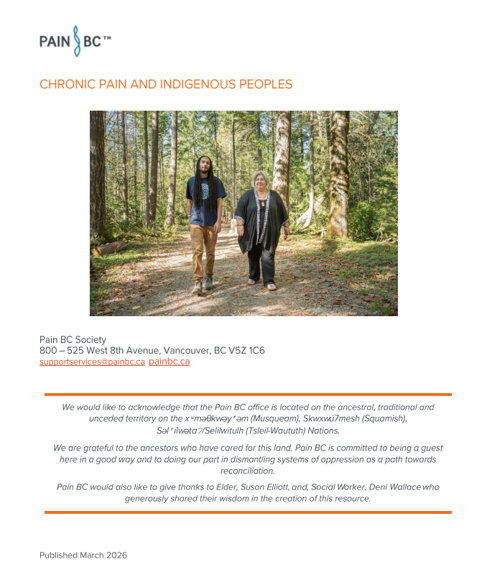
During the Fall 2025 semester I completed my practicum at PAIN B.C. My role was a co-facilitator within the Making Sense of Pain program for members of the Indigenous community. My practicum experience focused on learning how to facilitate Managing Sense of Pain (MSOP) Zoom based online sessions for nine weeks. Each week the program presented different topics, a series of sessions focusing on how participants can work toward alleviating their experiences with pain. We used a Biopsychosocial model, a trauma-informed care lens and Wholistic perspectives as part of our practice. In the photo to the left is an artifact I’d like to share of the work I completed with the PAIN B.C. team. It is a Making Sense of Pain Information document for the Indigenous community. As a team we agreed to collaborate with an Elder to ensure the document was inclusive of the experiences and needs of the members of the Indigenous community. The document is 14 pages in total. The key take away for me when I completed my practicum with the PAIN B.C. Making Sense of Pain program is that it provided the opportunity to bridge the gap between Western biomedical perspectives and Wholistic Indigenous worldviews of pain through integrating Indigenous peoples’ experiences with pain. It opened the opportunity to utilize traditional strengths and to identify and work toward understanding how historical and intergenerational trauma, colonization, and systemic racism are factors in achieving healthy outcomes when experiencing chronic pain. The link to the document is here:
Continuing My Journey:
As I continue my journey as an Indigenous based Social Worker my intention is to practice in way that I am true myself. Kovach (2021) spoke on the “relevance of being true to one’s worldview” (p. 150). It is a process where the importance of grounding our self and being mindful of the teachings provided by our Ancestors and Elders all while making sure humility is present in our actions and interventions. What is more, throughout the MSWSI program the readings and course work emphasized the importance of incorporating “Kirkness and Barnhardt’s (1991) four R’s [which] is respect, relevance, reciprocity and responsibility” (Kovach, 2021, p. 98) and how these principles are practiced and upheld within Indigenous based Social Work. I feel when utilizing these principles within one’s practice it guides a practitioner to bring the Wholistic framework theory to life.
Respect
is to value Indigenous Knowledge systems, cultural protocols and lived experiences. The guidance of Indigenous Elders help foster and understand how respect is practiced in community.
Relevance
is to ensure Social Work interventions, policies and support systems are reflective of Indigenous ways of knowing and being and tightly woven into Indigenous worldviews.
Responsibility
is upholding relational accountability to the community ensuring the Social Worker identifies systemic inequalities and provides support for Indigenous community members and all while promoting self determination.
Reciprocity
is to incorporate balance, a space where both the Social Worker and the community learn from and benefit one another. In the pic to the left, I am sharing an artifact that was created in the first week of the Master of Social Work with Indigenous Specialization during the Intensive week. It is a bracelet that I feel resembles reciprocity. I had no knowledge of the skill required to create this object and without the teaching of an Elder and my colleagues in the program I would have struggled more than I did when making it. I benefited from their teachings and feel I can too share what it takes to create this and similar items in the future.
Artifact 7


In following these values, I strongly feel it provides guidelines to be ethically responsible in the decision-making processes within my career and as an Indigenous community member. In the pic to the left I am sharing Artifact Eight. It is an Eagle Feather I received as a gift from an Elder in community as well as a Sage Bundle and Abalone shell I received from my colleagues at work. These items are essential tools I use in ceremony and provides a reminder of the importance of respecting our traditions.

Further, as I continue to my journey it would be amiss to not speak of the importance of grounding one’s self. I feel it is an important aspect of to provide balance in life. For me, the grounding work occurs when I visit the home community to which my Lil’wat family and community have existed for over a millennia. I am sharing Artifact 9. It is a pic of the mountains that surround the community, it is called Mount Currie. The time spent breathing in the fresh air, being by the rivers and the lakes in Lil’wat provides energy that regenerates my spirit. It is a different feeling from what I experience in the city of Vancouver.

Having the opportunity to visit my home Territory also serves as a reminder of who we are as Indigenous people. My grandparents would say to our family to not forgot who we are. We are known as the salmon people. The pic to the left, Artifact Ten, is how we as members of Stl’atl’imx nation preserve our food during the mid to late Summer months. It is called Ts’wan, wind dried fish and is a reminder of how we work together to ensure we have fish in our diet throughout the winter months. I feel it is much more than food, it is our identity as being known as the salmon people.


In the pics above, Arifact Eleven, is an advertisement for a Sweat Ceremony that takes place every two weeks in the DTES of Vancouver and structure of a Sweat Lodge. The members of Lil’wat Nation and Xaxsta First Nation travel from Stl’atl’imx Territory to the urban centre of Vancouver to facilitate the Sweat lodge. As mentioned earlier I spoke on the importance of integrating within one’s practice Traditional Ceremony to provide balance within one’s life. As part of my journey taking part in Sweat lodge will is one way I practice Indigenous ways of knowing and being.

Concluding and a Thank You:
In the photo to left is Artifact 12. I am with my colleagues in the UVIC MSWI program during 2024 September / August Intensive Week. I am seated in the back of the canoe as we continue our journey on the ocean. When we were on this journey, I became aware of how important it is to work together and to listen to our steward to ensure the travel on the canoe would be safe. In this way I feel that we all shared the same vision. I also feel as students within the program, we shared the same vison to create change in the way Social Work supports and services are provided for the members of the Indigenous community. Without the support of one another in the program it would be a great challenge to complete our studies. It is the same way we worked together to complete our day on the water.
I thank you for taking the time and energy to discover my E-Portfolio. I also want to thank all the people within the institutions I have accumulated my teachings and learnings as wells as the many Elders in community and work sites that I have been employed. Without their knowledge, dedication and time they have provided me I feel I would be a very different person today.
All my relations.
Connect with Me
hello@gradstudentportfolio.ca
Vancouver, BC
Absolon, K. (2019). Indigenous Wholistic Theory: A Knowledge Set for Practice1. First Peoples Child & Family Review, 14(1), 22–42. https://doi.org/10.7202/1071285ar
© 2026 First Nations Health Authority. All rights reserved. (n.d.). First Nations perspective on Health and Wellness - First Nations Health Authority (FNHA). First Nations Perspective on Health and Wellness. https://fnha.ca/wellness/spirit-and-culture/first-nations-perspective-on-health-and-wellness/
Kovach, M. (2021). Indigenous methodologies: Characteristics, conversations, and contexts. University of Toronto Press. Second Edition.
Pedri-Spade, C. (2016). ʺThe Drum Is Your Documentʺ: Decolonizing Research Through Anishinabe Song and Story. International Review of Qualitative Research, 9(4), 385–406. https://doi.org/10.1525/irqr.2016.9.4.385
Pedri-Spade, C. (2016). ʺThe Drum Is Your Documentʺ: Decolonizing Research Through Anishinabe Song and Story. International Review of Qualitative Research, 9(4), 385–406. https://doi.org/10.1525/irqr.2016.9.4.385
Wilson, A. C. (2004). Introduction: Indigenous Knowledge Recovery Is Indigenous Empowerment. American Indian Quarterly, 28(3/4), 359–372. https://doi.org/10.1353/aiq.2004.0111
References: